

Money. One of the things that most likely all humans have either desired or despised. Whether it’s problems with rent or wanting that new designer jacket that is out of your budget, it seems that money can buy anything people desire. However, can it really buy someone happiness?
Money can, in fact, buy happiness. Money can solve infinite problems. Someone breaks a bone, and the doctor keeps handing the patient the bill, even if the patient is biting back a shriek of pain. Now, they just have to sit in crippling medical debt because they had the misfortune of not having the one thing that truly buys people out of anything. Money has been a universal solace for depression for most, tracing all the way back to the seventh century B.C., according to Public Broadcasting Services (PBS).

Purchasing things releases dopamine, a neurotransmitter that produces a feeling of exhilaration and thrill. Psychologist Susan Albers supported this theory in an article published by The Cleveland Clinic, titled Why Retail Therapy Makes You Feel Happier.
“Shopping gets us to visualize positive outcomes, and visualization is a powerful tool. Visualization creates positive anticipation and reduces anxiety,” said Albers.
Visualization has also stayed a proven way to improve mental well-being, whether it comes to having a daydream about buying a dream car or even a simple vision board on buying a delicious sandwich from a shop that is far away.
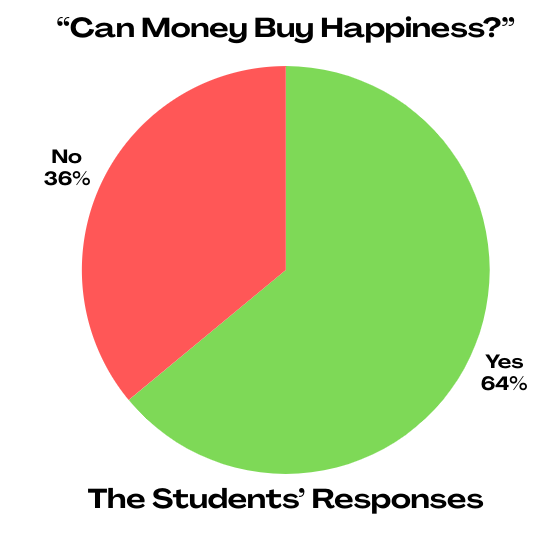
Out of curiosity, A poll of 100 students at Northwest High School (NWHS) was conducted on the question of whether they thought money could buy happiness. The responses varied between students; the green, with 64 percent here, represents students who agree. The red with 36 percent showcases students here who think otherwise. The group of students that were pulled are all from different grade levels and classes. Looking at the data, the majority of the students here at NWHS agree that money is a solution for happiness.
Others debate that money can buy happiness, for example, the other 36 percent of students I polled. One of those students was freshman Claira Post, who’s a socialite.
“I don’t think money can buy happiness because it can’t buy you valuable relationships as well as the ones you build and gain by yourself.” says Post.
Post represents the opposite side of the topic that money can buy happiness, going against the other 64 percent.

Kamaljit “Kim” Kaur, a college student who moved from Michigan to New Jersey, agrees that money can buy happiness.
“I agree that money can buy happiness because it funds my further education and helps me become more open to different job applications, especially as a teacher. I feel that the more education I get, the more I can teach my future students,” says Kaur.
The topic of whether money can buy happiness will continue to be an ongoing conversation starter for who knows how much longer. Hopefully, this opinion will be taken into consideration for the next time someone brings up the topic of whether money can buy happiness or not.