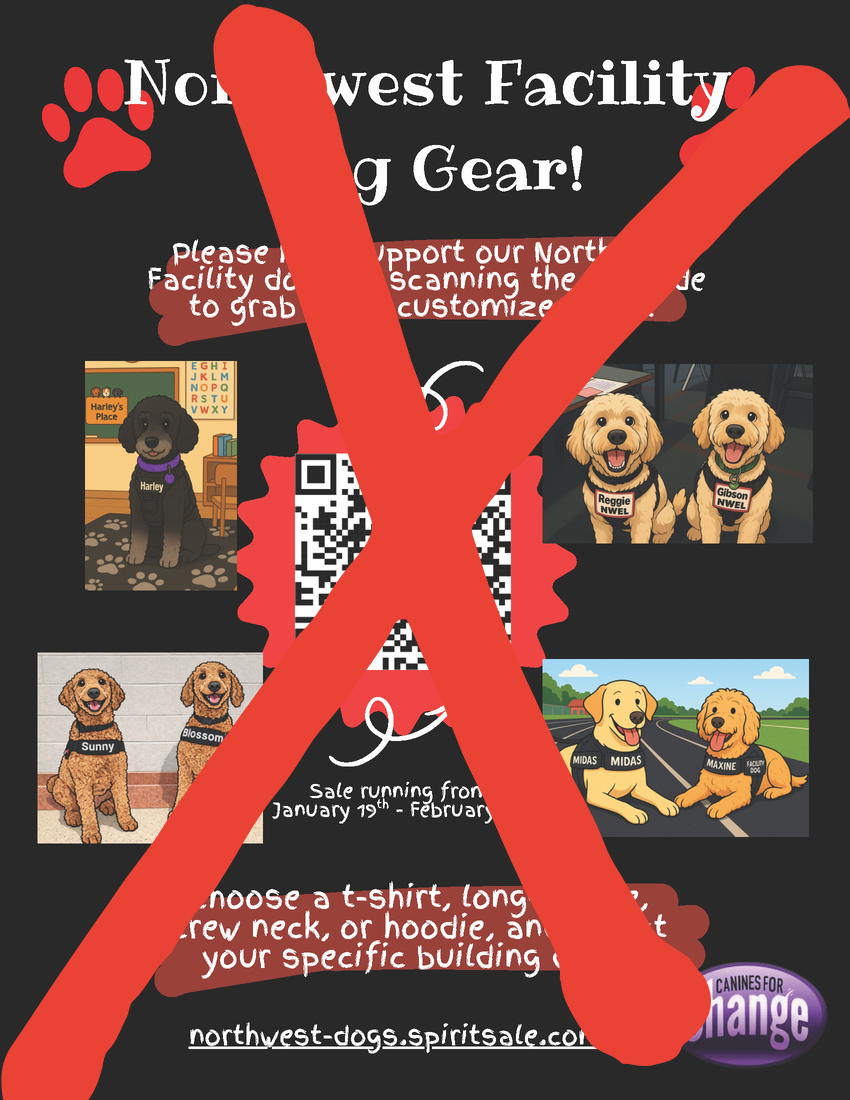
The school’s decision to sell AI-generated shirts completely contradicts its message that it encourages students to be creative and independent. The school has recently created merchandise to support the facility dogs – Midas and Maxine at the high school, Blossom and Sunny at the middle school, Gibson and Reggie at the elementary, and Miggz and Harley at the early elementary. This isn’t an issue in itself; the issue is that the products contain Artificial Intelligence (AI).
We are constantly told that our ideas matter and that expressing ourselves is important. Yet when it came to designing and selling merchandise for the canine team, they chose to use computer-generated images rather than the work of talented students. We can’t be expected to embrace creativity when it’s actively being replaced.
The school is filled with talented students who pour time, effort, and passion into their art. Choosing AI instead of them diligently sends them another message that their work is secondary and optional. That message directly undermines everything we’re encouraged to believe about our potential.
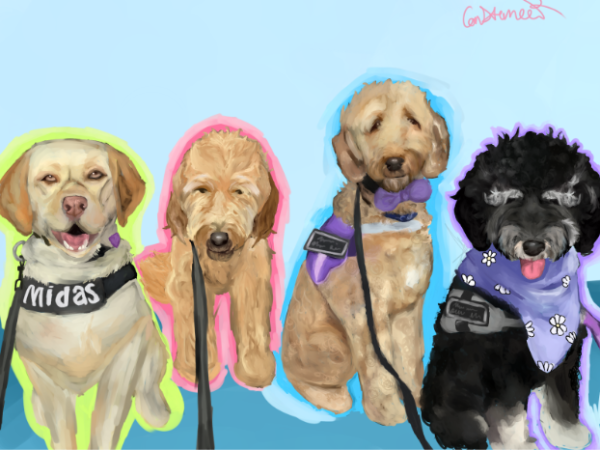
Highlighting artwork like this drawing, created by sophomore Constance Roquemore, shows that there are already talented artists in the school who could have contributed to the fundraiser. Her piece is just one example of the student’s creativity. Roquemore’s drawing captures the personalities of each dog and still shows the illustrated style that the school was aiming for. But the administration still has its own reasons for not choosing those designs.
To better understand the school’s reasoning, I interviewed one of our biology teachers, Tobi Skaggs, who also handles one of the facility dogs. She explained that AI was used as a practical tool. “AI is a tool,” said Skaggs. “Just like any tool, you have to learn how to use it appropriately.” She believes the canine team shirts were an example of appropriate use because they were not used for assignments and were a part of a fundraiser.
Skaggs also pointed out that cost and time were important factors. “If we didn’t use AI, we would have had to take them to a designer to design the shirts, which costs a lot of money,” said Skaggs.
The shirts were meant to raise money; spending too much money on the design would reduce the profits. She also mentioned that using AI helped them make something “fast and fun” for the elementary students.
“Since a handler at the elementary school created the shirts, she made them for the younger kids and not so much for adults and older kids, as those were the point of our previous shirts,” said Skaggs
When asked if using real photos of the dogs would have been better, she said it definitely would have been “a different style.” The shirts were made to look more cartoon-like and fascinating for the younger students. While using real pictures was possible, she explained that it would take more time and effort to do so.
However, even with these explanations, there is a clear double standard. Students are constantly warned about plagiarism and academic dishonesty. Students are reminded to cite sources and
respect other people’s work; meanwhile, AI generators steal artwork from real artists without their consent. Even if it is technically allowed, it clashes with the ethical standards that students are expected to follow. Integrity should not be optional and ignored when it is convenient.
The facility dogs are trained to provide comfort and emotional support to help students feel safe, comfortable, and less anxious in school. Students form real bonds with them, and using AI images of them makes them feel distant and artificial by taking away their distinguishable characteristics and elements. When students see the AI-generated photo, their connection to the dog may feel weaker because the picture does not convey the dog’s same personality. A real picture or a student-created design would actually reflect what the canine team stands for, something an algorithm simply can not do.
So it’s not about being against all technology; it’s about making sure that it supports student ideas instead of replacing them. Schools should be the one place where creativity is expanded, not seen as expendable.